Noora Hosseinzadeh
Staff Writer
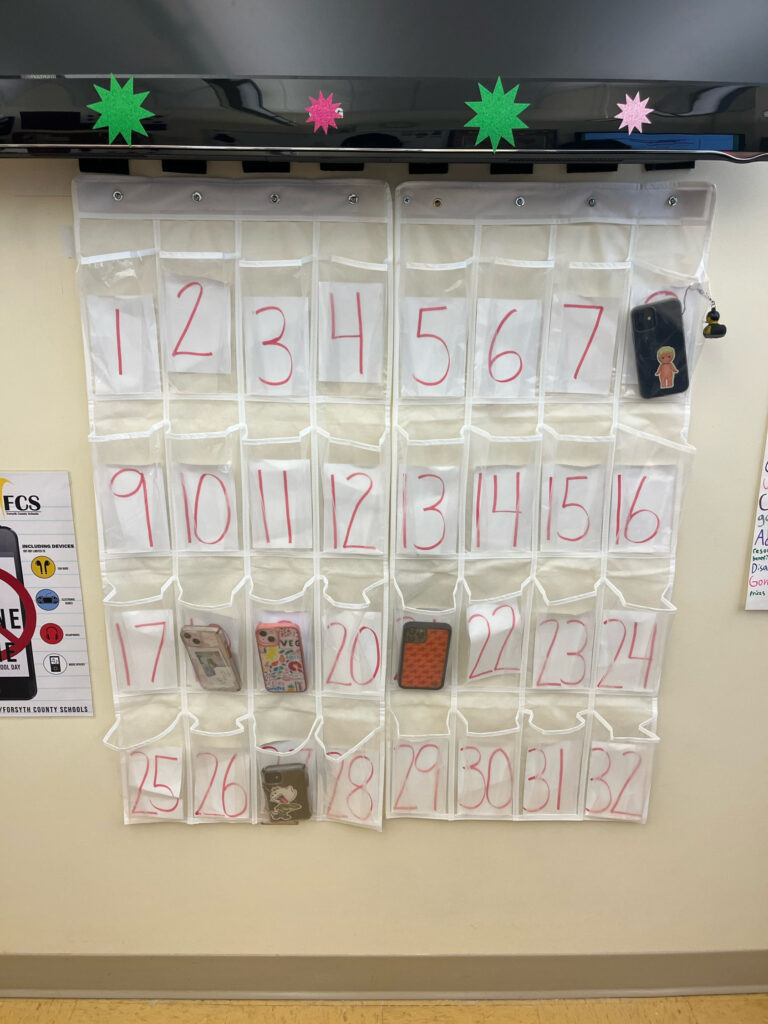
It could be considered common sense that phones should be banned from the classroom. With teachers fighting a constant battle to get their students to focus, eliminating the hand-held distraction should be an easy decision; however, is banning phones as simple as it sounds?
Ever since COVID-19 moved physical classrooms to Zoom, schools across America have become more dependent on technology than ever before. iPhones have reached their full potential to become a key educational tool in the classroom. From research to note-taking to utilizing educational apps, the iPhone can do it all, and the current phone policy overlooks all of this in favor of total restriction.
Many arts-related classes across R.J. Reynolds High School have struggled to adapt to the new phone policy. Previously, submitting artwork, getting interviews, and taking photos was done in a cinch. But now, many of these classes struggle to find a substitute.
“To provide funding for the yearbook, we make phone calls to get sponsors,” Emmy Henthorn, an editor of the RJR yearbook, said. “If we get enough sponsors, we’re able to give away yearbooks for free to make sure everyone can get them. It’s easier to do during the school day because everywhere is open at that time when most are closed after I get home from sports practice at six PM.”
In addition to the convenience of phones for certain classes, they are an imperative communication tool. Communication is key to a successful school year, as seen through the rise of apps like Remind and GroupMe. Anything can happen during a seven-hour school day and teachers are constantly messaging their students to let them know of a room change, essentials for class, or sometimes even letting them know of an emergency. The same applies to sports coaches, club leaders, and of course, parents.
“We use Remind, GroupMe, and text pretty regularly to communicate during the school day,” Elizabeth Kim, a three-sport athlete at RJR, said. “Recently, we had a tennis match get canceled, but I didn’t know about it until I had already left class under the assumption that it was still on. When I didn’t see my coach, I finally checked my phone that I’d put up during class, just to find out the match had been canceled.”
The modern reliance on phones in schools could have been prevented if it had been enacted years earlier. But now, the idea of banning phones is completely infeasible. Going significant amounts of time without checking your screen isn’t possible without missing out on opportunities, complicating simple tasks, and not being up to date. If our school culture was less phone-oriented, maybe we could begin the process of totally silencing the ping, but for now, we’re bound to these devices.