Will Bumgarner
Editor-In-Chief
As election day swiftly approaches, many voters look to the ballet with questions. In a year of high political tension, the right to vote is not to be overlooked. R.J. Reynolds High School stepped in to do its part to educate voters by hosting the Forsyth County Commissioner Candidate Forum on October 2nd. Four students at RJR spearheaded the event, along with Government and Politics Teacher Cristofer Wiley.
“At the end of our AP Government and Politics class, we were assigned a civil literacy project,” Junior Katy Cox said. “Basically, taking all of what you learned throughout the year and applying that to your own lives. And so we decided for our project to do this forum because there was a school board forum similar to this for that election two years ago, and so we thought that would be a great thing for us to do for this election.”
The event was primarily student-led, student-moderated, and student-attended, providing a civic space for youth to inform themselves about those who hope to represent them.
“Obviously, schools are something that a county has a great impact on,” Cox said. “So I think just a lot of times adults may look at us and think we don’t know what we’re talking about or don’t think that we even care. But it’s impacting our everyday lives. They talked about the metal detectors, school safety, and about teacher pay. So allowing students to have a platform for them to come in and speak their mind and get the questions asked that they are curious about is so important.”
They believed highlighting the county commissioner candidates was especially vital because it is a position people tend to know little about.
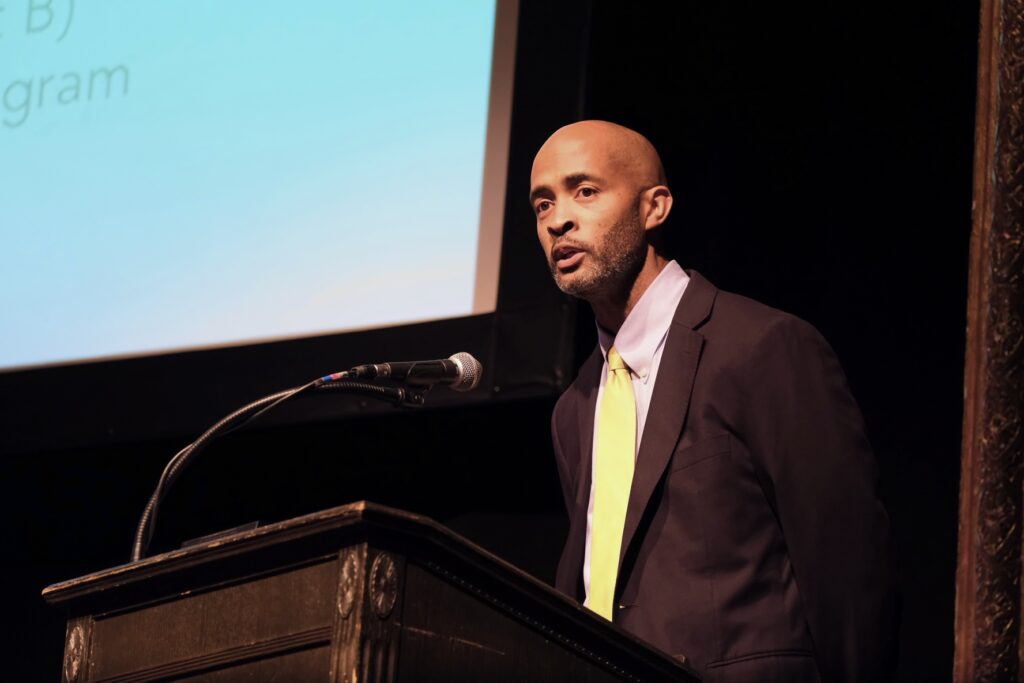
Christopher Wiley addresses the Forsyth County Commissioner Candidate Forum. Photo provided by Will Bumgarner.
“In a very real way, the biggest job of the County Commissioner is a balancing act between a lot of worthwhile services, endeavors, expenditures and to improve the lives of the people in Forsyth County,” Wiley said. “Another part of the balancing act to say, do we raise taxes for the good of all the things that people want, the things that people need within the county, or do we make do with what we’ve got and leave the tax rate unchanged.”
Throughout the event, Education was heavily emphasized in the conversations regarding the budget, with the Democratic candidates taking the strongest stance in support of an increase in school funding.
“It’d be great to say that county commissioners should just shovel as much money as they can towards education, but education has to be understood as it coexists with things like public safety and health services and a slew of other things that are just as necessary,” Wiley said. “It’s almost a Spider web of contingencies, and when you tug on this string, that’s gonna dance up on the other side, so there are no real easy answers, but the County Commissioners are the ones who sit in that seat to decide where the dollars go.”
A big motive for the event was to educate students on this balancing act while also engaging them in the political process as a whole.
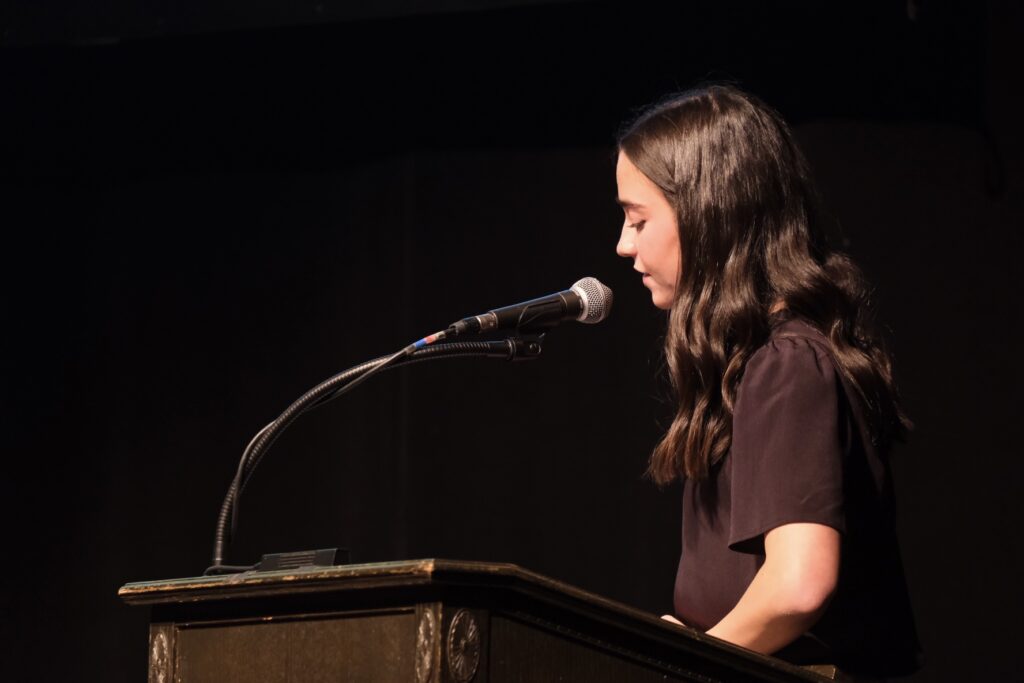
“Most students have an idea of who’s at the top of the tickets, your presidential candidates, vice presidential, but I’d venture to say that the knowledge base for everybody else on the ballot probably declines as you go further and further down,” Wiley said. “Empowering [students] to be the ones asking the questions, writing the questions, moderating the event feels like the right thing to do as they make their way from being kids to the adults that they’ll become.”
Along with Cox, Juniors Helen Wilson, Finley Reynolds, and Nylah Lee planned and moderated the event. They hope that the forum will inspire others to delve into the voting process.
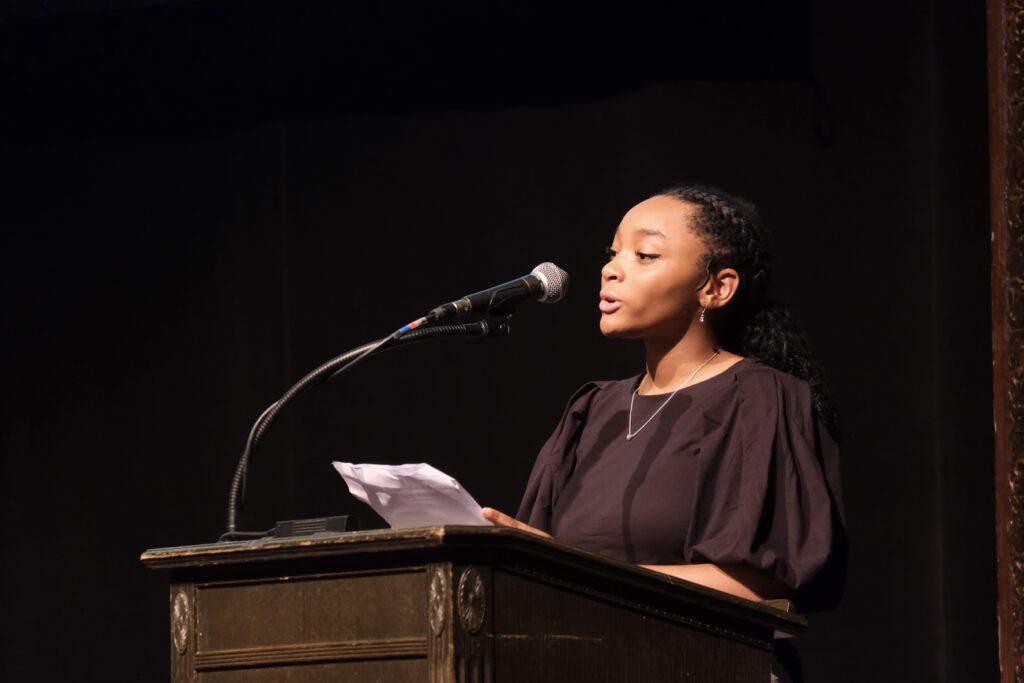
Junior Nylah Lee poses a question to the Forsyth County Commissioner Candidate Forum. Photo provided by Will Bumgarner.
“I think it’s so important because, by the time you turn 18, you can cast your vote, and if you wait till then to get involved and ask questions, then your vote is not going to be an informed vote,” Cox said.
While students will shape the progress of tomorrow, it’s important that all voters stay educated on candidates and policy. Wiley hopes that people will make decisions based on research rather than just a letter next to their name.
“I hope that’s a habit that they keep throughout their civic lives,” Wiley said. “Quite honestly, I don’t think it’s overshooting it to say some of my former students see themselves as somebody who could run for office and could be a part of making those decisions someday. So that would just be a nice little final exam.”