By Maddie Kunkle
Staff Writer
As students begin second semester, there is a lot of talk about AP exams and other standardized tests, such as the Pre-ACT and the Pre-SAT. These exams are rapidly approaching, and it’s suggested that students begin studying for them in advance. So, you may be curious what is the best way to prepare yourself for these tests?
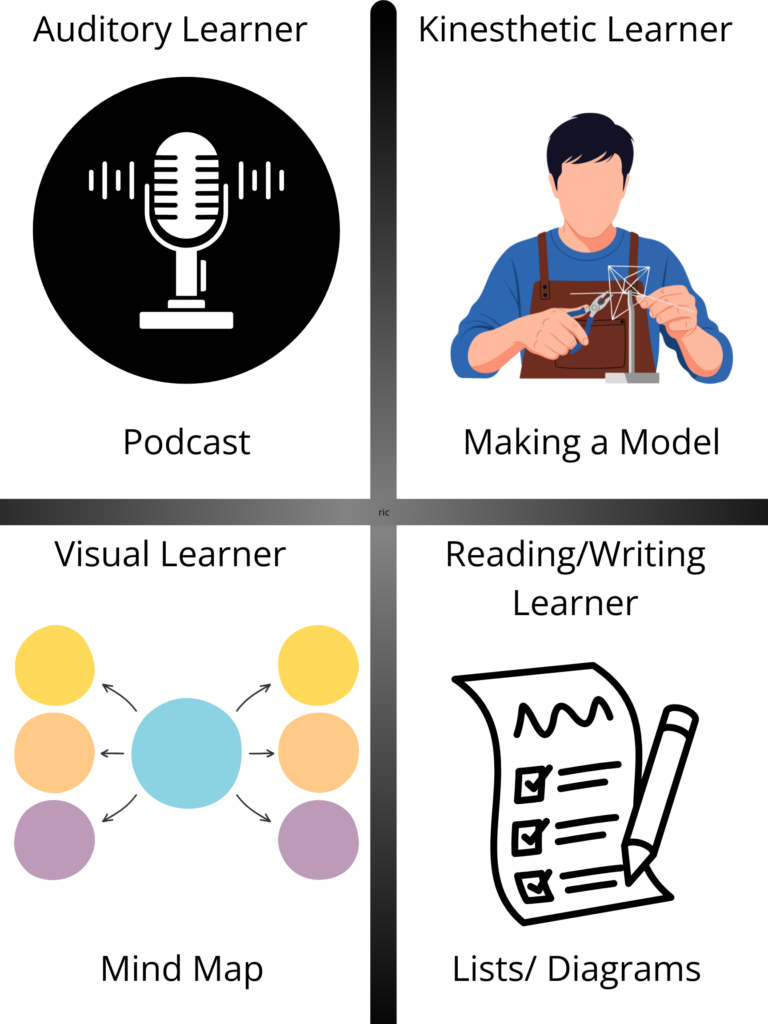
There are four main types of learners: visual, auditory, kinesthetic, and reading/writing learners. A kinesthetic learner learns differently from an auditory, a visual, or a reading/writing learner, and vice versa. So, if a kinesthetic learner were to try to study using a method that works best for auditory learners, it may not be as effective. Knowing your learning style will help to ensure that you are thoroughly prepared for these exams. The first type of learner is a visual learner. Visual learners need to see things to understand them. Graphs, maps, and diagrams are all examples of presenting information in a way that is best for a visual learner to interpret. Visual learners also learn best when things are demonstrated to them in patterns, shapes, or colors. Making information visually pleasing, such as putting together a mind map, is considered to be one of the best methods of studying for visual learners.
As a visual learner myself, I find that color-coding different concepts and/or putting information on color-coded notecards to review is beneficial and allows me to perform to my best ability. If you believe yourself to be a visual learner, then any sort of color-coded or eye-catching studying method will work best for you.
The second type of learner is an auditory one. Auditory learners find that they remember and understand things best when things are spoken aloud to them, or they speak things aloud themselves.
Lectures, discussions, and teaching concepts themselves allow auditory learners to process information. For an auditory learner, recording a podcast on a given topic and listening back to it is a successful way of studying. Additionally, teaching a friend or studying with one is also particularly effective for auditory learners because they are able to hear the information out loud.
In contrast to both auditory and visual learners, kinesthetic learners need to actively get their hands on something to understand how it works. Kinesthetic learners like to learn and study in tactile ways. They need to perform experiments or carry out specific activities to learn to the best of their ability.
Kinesthetic learners may like to make a model of information or create a project based on that information to allow themselves to see and apply their skills. Interestingly enough, moving one’s body, such as chewing gum, pacing, and/or tapping their foot, helps some kinesthetic learners to increase their attention on their studies. Kinesthetic learners should take advantage of these methods in order to enhance their learning style and studying tactics.
The final learning style is a mixture of the other three types of learning. Reading/writing learners can use methods that consist of visual, auditory, and kinesthetic learning methods. These types of learners prefer to see things written down or be able to read about them. They also like to speak aloud to understand different concepts. Reading/writing learners like to create projects/presentations to display their information, they tend to be organized, and they like to create lists and/or diagrams to put information into different categories. These learners also like to receive feedback on their work so they can improve upon it. If you are someone that feels these methods apply to, using a combination of the studying methods for auditory, visual, and kinesthetic learners is the best way to ensure you are achieving your fullest potential.
Ultimately, the way you study is up to you. However, knowing what your learning style is could completely change the game for you. Perhaps you weren’t bad at studying; you just didn’t know the best way to study according to your learning style. Take a chance on yourself, figure out what your learning style is, and maximise your results on exams.