By Kate Sturgill
Staff Writer
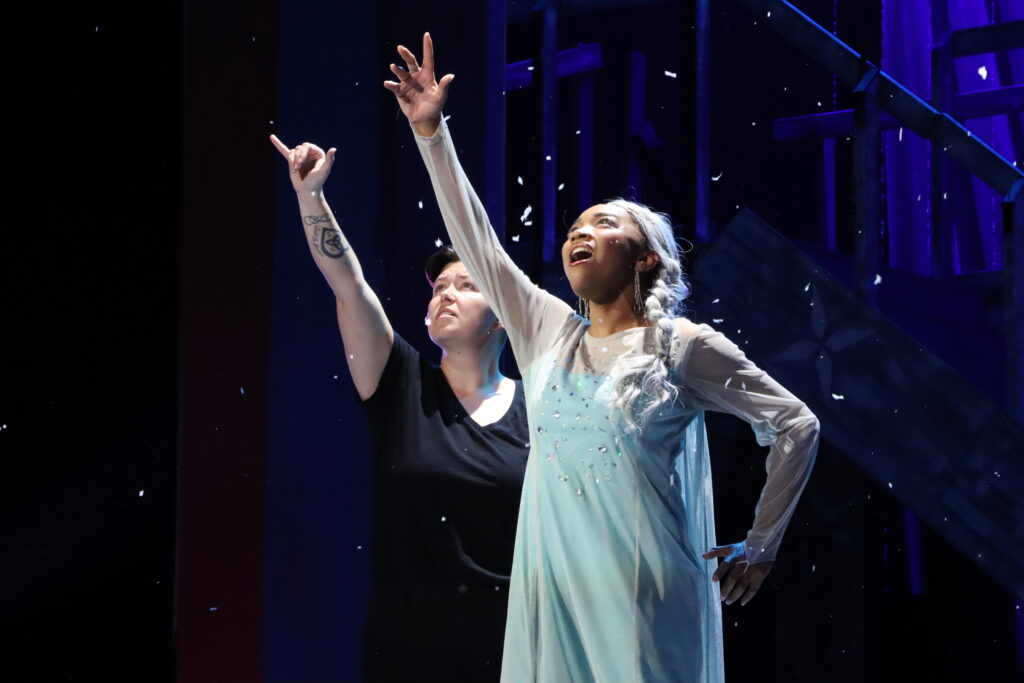
Kiyomi Wisnasky interprets for Nylah Lee performing ‘Let it Go’ as Elsa.
With Disney’s Frozen, R. J. Reynolds High School made history as the first high school in North Carolina to put on a production with American Sign Language shadow interpreters on stage, moving alongside the characters. This isn’t just the first time Reynolds is breaking barriers with ASL, though. Reynolds was the first school in the district to have an ASL program, thanks to the efforts of Aimee Falk, who had previously interpreted for Reynolds. The goal of this addition was to include the deaf population of the Winston-Salem community, allowing them to enjoy Frozen put on by the Reynolds Theatre Department.
Typically, when Reynolds has assemblies, the interpreters stand off to the side in a stationary spot, leaving the deaf secluded to one area of the audience. The placement of the interpreters suggests that not much thought was given to the select few deaf students watching, and it was a mere hope that they could see the performance well enough. Having shadow interpreters follow the characters around the stage gives deaf audience members a wider range of seating while still being able to engage with the show.
Aimee Falk, the ASL teacher at Reynolds, has been excited about the inclusion of the deaf community in this show, and she is confident in her team’s ability to make young deaf students feel included. She also had the job of ensuring the show looked seamless and could be thoroughly enjoyed by a deaf audience.
“[This is] a great thing for the deaf community,” Falk said. “They are gonna feel included. They are not gonna feel like an afterthought; [typically] the interpreters are off to the side because they have to be there. The [deaf] actually get to enjoy the show instead of looking to the center, to the right, to the center, to the right, and it’s in their language, and they get to have the same experience as everyone else with the accessibility we are providing.”
The new theatre teacher, Jennifer Pierce, has now settled into a rhythm after an exciting first semester directing the fall play, All in the Timing. She’s now confident and ready to take the musical on in stride, while embracing the chaos and bustle of over 120 students working tirelessly to make the musical run smoothly.
The addition of the ASL interpreters certainly adds another aspect to the show that can make choreography feel chaotic at rehearsal. That being said, as complicated as it was to incorporate, it will be worth it to make our city’s deaf community feel seen and represented in this show.
“We’re really proud to do this groundbreaking work with the University of North Carolina Greensboro and the ASL staff here, as well as some ASL students who are in Ms. Falk’s amazing program,” Pierce said. “This is going to be not just an interpreted show, but a shadow performance where the signers are actually on stage for the performance. It’s really going to be important for outreach to the deaf community… young, deaf children are going to be able to see themselves represented, so that’s going to be fantastic.”
Another person who is responsible for organizing and orchestrating the ASL shadow interpretation is Ash Henley, a Reynolds sophomore who has volunteered to help communicate with the UNCG sign language team. She is also in charge of marshaling the ASL students at Reynolds who are shadow interpreting on the production, as well as communicating with local schools like the Morganton School for the Deaf, which have students who would be interested in watching the show.
“The students first volunteered their interest and were then approved by Ms. Falk based on current ASL proficiency, commitment, and experience with the student to ensure they would be able and confident signing on stage,” Henley said. “I started making this happen with Ms. Falk and other interpreters in December. In January, interpreters got scripts and began learning the show. Interns weren’t confirmed until February, but they have been working [a lot] to learn their lines.”
While this is an impressive achievement for Reynolds as a school, it comes with some drawbacks. Will Lovett, who plays King Agnarr, has noticed that rehearsals have become increasingly more complex with the addition of shadow interpreters to the show. Not only are there more people on stage, but with all of the movements (like dance numbers), it quickly becomes crowded if the interpreters don’t move fluidly with the characters. This requires tremendous amounts of practice, but fortunately, Reynolds has a great theatre team willing to put in the necessary work.
“Rehearsals have definitely been longer and a bit more arduous with the addition of the new [ASL] crew, and sometimes it’s hard to find my place and get where I need to go when moving around the stage,” Lovett said. “Although it sometimes feels complicated, we are actively working every day to clean things up, and I’m confident everything will run smoothly come opening night. I’m glad we get to include many young individuals who don’t feel seen in the theatre realm, so it’s one hundred percent worth the time we’re putting in.”
Even though setbacks occur with the addition of the shadow interpreters, making the deaf community of North Carolina feel actively engaged with a musical of this regard is well worth the time and effort. As of March 26, Reynolds makes history and contributes to a new, inclusive side of North Carolina high school theatre.