By Evie Beale
Editor-in-Chief
Over the summer, the Winston-Salem/Forsyth County School System implemented a new policy: a complete ban on metal water bottles. After several incidents in which metal water bottles were used to harm other students, district representatives advised the WS/FCS Board of Education to implement a new policy.
With the new protocol in place, students are no longer permitted to use metal or tinted water bottles. Instead, the district requires students to carry clear plastic water bottles or clear tumblers.
“[The policy was adopted] to protect students, staff, and visitors to our schools from items that could potentially be used as weapons or to bring in unauthorized items to the school environment,” WS/FCS Security Director Chad Williams said.
According to Williams, this policy is likely to remain permanent. Students have expressed frustration with the policy because they feel that many different items could be used as weapons, not just water bottles. Cherish Alston, an R.J. Reynolds High School student, shares these concerns.
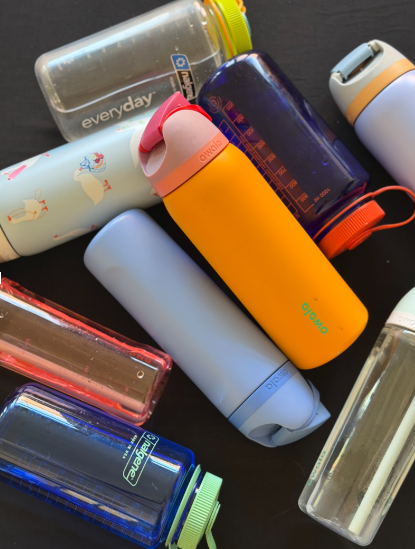
An R.J. Reynolds High School class’s water bottles compiled.
“[The policy] was implemented to stop injuries, but if you remove water bottles, people will find other ways to make people have injuries,” Alston said.
While one of the concerns regarding the policy is how many resources are available to cause harm in schools, many community members believe the district has more pressing issues to address.
“As someone who’s in school all of the time, I think we have a lot of bigger issues to deal with than what kind of water bottle our students bring water in,” former Reynolds PTSA president Laura Neelon said.
Many students have asserted that while the policy is implemented across the district, its enforcement varies from school to school. At a school across the district from Reynolds, West Forsyth sophomore Lorena Vazquez-Materdl has noticed differences in enforcement at her home school, West, and at Career Center High School where she takes a few classes.
“At West, they really watch the students,” Vazquez-Materdl said. “In fact, when I was helping with freshman orientation, one of the assistant principals saw me carrying a metal water bottle and basically yelled at me, telling me I couldn’t bring one.”
The policy is not just limited to the school day, though; students involved in after-school activities must abide by the policy as well. For instance, many student-athletes have struggled to hydrate at practice because their new water bottles result in their water getting unbearably hot very quickly.
“I think it’s ridiculous that [metal water bottles] can’t be used in sports practices,” Neelon said. “Students need to stay hydrated.”
For now, the policy is implemented, and students are to abide by it. There are resources in the local community and online websites that provide access to purchasing clear water bottles. Williams recommends checking out the Code of Conduct if people have more questions.