Briggs Brown
Staff Writer
In 1967-68, Jon Sawyer, founder and CEO of the Pulitzer Center, walked the halls of R.J. Reynolds High School as a tenth grader, unaware that his time there would later play a critical role in his career in journalism and global storytelling. Sawyer only attended RJR for one school year, but it would have a lasting impact on his life, in part because he attended the same year of the global churning assassinations of Martin Luther King Jr. and Robert F. Kennedy.
The tragic events of 1967-68 created a unique bond among students. Sawyer often revisits the trauma of that time, when the streets were filled with riots and protests, as he connects it with the divisiveness of modern times.

“I made many friends I cherish at Reynolds that year, several of them still close after five decades plus,” Sawyer said. “And [I] have followed the lives of many classmates with admiration and interest.”
Although Sawyer left for boarding school in New Hampshire his junior year, he kept close ties to Reynolds through his friends and family.
“Our mother was active in local education,” Sawyer said. “serving as president of the RJR Parent–Teacher Association and later as a member of the Winston-Salem/Forsyth County school board. She was a strong advocate there for desegregation of local schools and equal funding for every student.”
His mother’s passion for justice and education was instilled in Sawyer as he continued his academic journey at Yale University, where he majored in English and History. Sawyer returned to Winston-Salem during his college summers to work an internship for the Winston-Salem Journal, who at the time, were leaders in civil rights, environmental protection, and opposition to the Vietnam War.
“I was assigned to the editorial page,” Sawyer said, “working under Wally [Wallace Carroll], John Eslinger, and Roy Goodman, who did their best to wean me off the loquacious wordiness I had picked up—at Yale.”
Wallace Carroll was a decorated journalist who worked for The New York Times and the United Press International. Carroll played an influential role in Sawyer’s career, guiding him in his work that would later help him land a job at the St. Louis Post-Dispatch after graduation.
“I worked on the editorial page for three years,” Sawyer said, “in local news and business coverage for three more, and in 1980 joined the newspaper’s Washington Bureau. I spent twenty-five years in the bureau, half of them as bureau chief, leading a team of seven journalists. For much of that time, I focused on enterprise reporting, with on average two substantial foreign projects each year and the opportunity to report in over eighty countries.”
Sawyer fell in love with foreign reporting. He was intrigued by the wonders he was exposed to, having the opportunity to witness world-shaping events first-hand. However, in 2004, during the midst of the Afghanistan War, it became apparent to Sawyer the disconnect between what he was hearing on the ground about the warmongering decisions of the U.S. military and the strong consensus in favor of those pro-war decisions back in the United States.
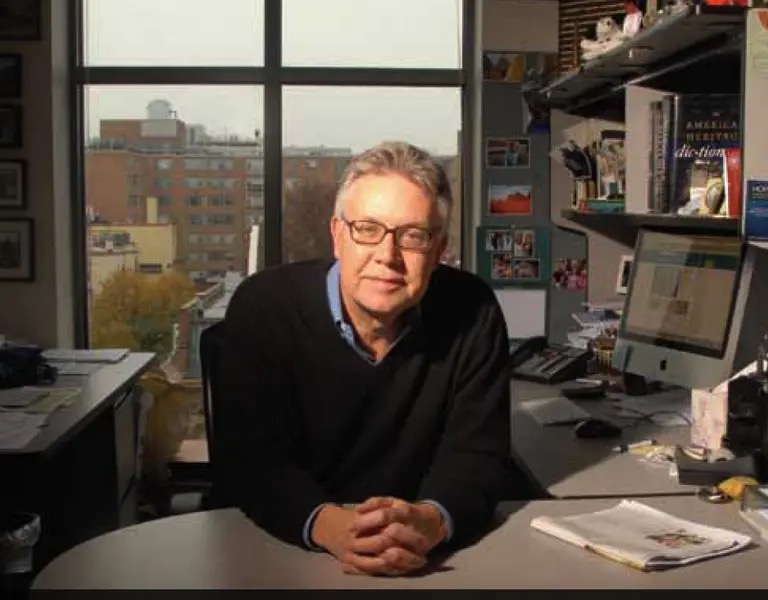
“I felt that we journalists had failed in our responsibility to hold leaders accountable, and to assure the public that they were getting all the perspectives and context they needed to ensure good policy decisions by the leaders we choose.” Sawyer said.
Motivated by this notion, Sawyer returned to ask the Pulitzer family, the owners of the Post-Dispatch who had recently sold it, to help him create an organization that would help bridge the disconnect between the ground and the United States.
“The Pulitzer family agreed to give me enough ‘seed money’ to get started, launching the Pulitzer Center in January 2006 with a single employee (me) and a borrowed desk.” Sawyer said.
The Pulitzer Center has grown into a multimillion-dollar organization with over sixty staff members, working in fifteen countries and supporting over two hundred professional journalism projects each year. They support this initiative with the money they receive in contributions from several foundations and donors, a significant donor being the government of Norway. This money is then allocated to individual projects in grants, ranging anywhere from several hundreds of dollars to tens of thousands of dollars.
“Projects supported by the Pulitzer Center have won every significant journalism prize,” Sawyer said. “From Emmys and the Peabody for our broadcast work, to awards from the Overseas Press Club, the National Press Club, the ‘Gabo’ awards for best reporting in Latin America, and the Pulitzer Prize.”
With all of his successes, Sawyer still remained humble to his beginnings. The Pulitzer Center has done many stories on RJR and the Winston-Salem area, highlighting them for the world to see, such as parts of the 1619 Project done by The New York Times, reexamining the legacy of slavery in modern American life. Sawyer is a frontrunner in the growth of journalism and is excited to see the Reynolds Journalism Department continue to grow.
“Go out and report! Be rigorous in getting the facts,” Sawyer said. “Write as much as you can on as many topics as possible. Explore the many other media for communication, from photography and short docs to Instagram and TikTok. Be open to other points of view and fair to the people on whom you report!”