By Mackenzie Acker
Features Editor
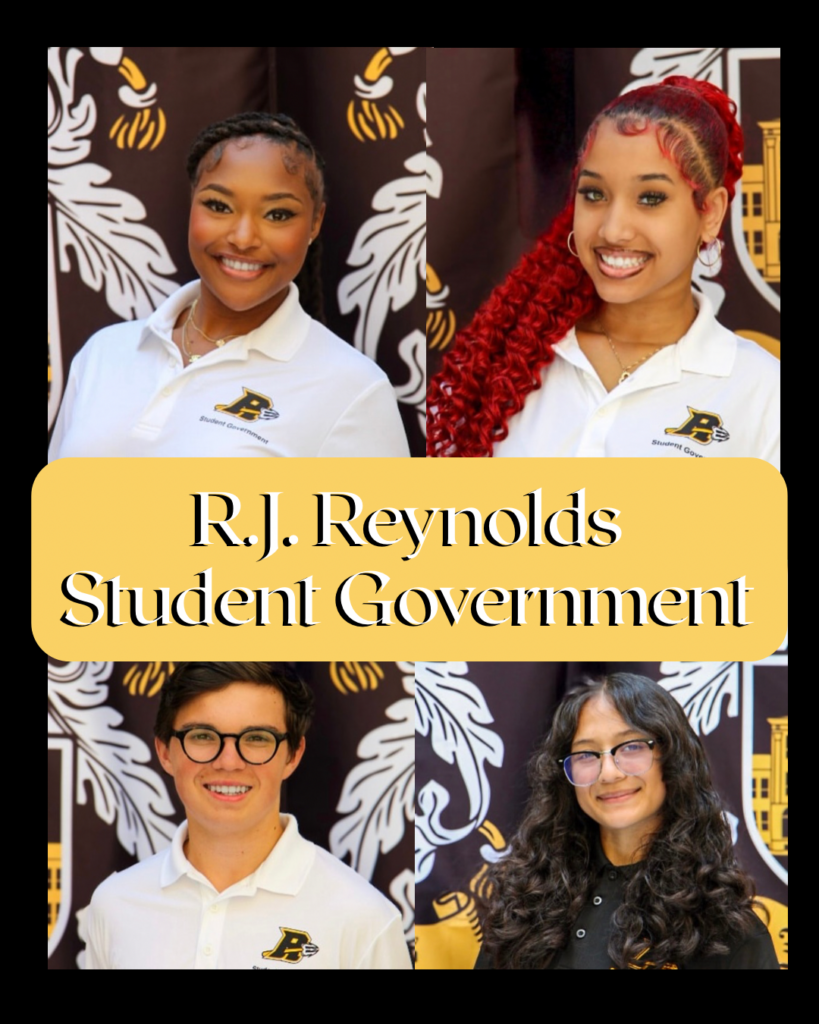
R.J. Reynolds Student Government representatives Frií Sampson Young, Kelis McGuire, Grant Cameron, and Jolette Perez-Flores (left to right).
Most students have heard of our student government, but far fewer can explain what SGA actually does. At R.J. Reynolds High School, our Student Government Association (SGA) exists as both a visible presence and a largely misunderstood one, shaping events, responding to concerns, and influencing student life in ways that often go unnoticed. This gap between perception and reality reveals something deeper about how representation works at RJR and whether students truly feel heard by the system meant to serve them.
“Honestly, I don’t really know what they do,” sophomore Ollie Fala said. “I feel represented by Grant, my sophomore representative, but I don’t really know about any other candidates other than him.”
Some students feel disconnected from the student government, while others are critical of its work. The structure of SGA is purely representative, leaving students with little input besides voting in general elections. Although this can make for an efficient student government–one modeled after the United States system–many students still feel their voices aren’t being heard. When only a small group of students are the decision-makers, general concerns can go unrecognized.
“I feel like there’s no communication specifically about club days, afternoon, or morning,” Fala said. “Also, when we have testing days, teachers say, ‘We can’t tell you not to come to school, but unless you want to sit in my class all day.’ But then other teachers say, ‘I’ll be posting assignments on canvas.’”
Despite popular criticism, a closer look shows that SGA has made an effort to improve student communication in the past year.
This work often goes unnoticed by the student body, and many unsatisfied students might simply be uninformed about how SGA works to better the school.
“A lot of people don’t know, but for Math 1 and Math 3 students each year before EOCs, we host a math Blitz,” Student Body President Frií Sampson Young said. “Teachers come, and they give students a crash course on how to take the test. We then serve them lunch and breakfast, along with snacks.”
SGA also gets involved in student life, most notably by reinstating and planning homecoming.
“As a member of SGA, you’re planning homecoming,” Sampson Young said. “You’re planning all of the major events, like the Hispanic Heritage Festival and other things that class representatives propose.”
These events are examples of how SGA encourages independence and creativity when solving problems at RJR. This was evident in SGA starting the Demon Pantry, a resource where students can receive food and other essential items free of cost. This innovative environment is fostered by the faculty advisor, Philip Boyd.
“Each time we meet, we have an agenda,” Philip Boyd, RJR teacher and SGA advisor, said. “We talk about initiatives that the representatives want to complete and any student concerns that may come up. Some students might have something that they want to protest or something that they care deeply about. If it’s something that SGA wants to take on, then they bring it up in the meeting, and we take it on.”
SGA did just that when they supported the student walkout regarding the WSFCS budget crisis and debt scandal. After students independently posted about the walkout on social media, SGA stepped in to encourage student voices while maintaining order and safety. However, SGA still walks a fine line between supporting students and encroaching on issues that are deemed too controversial.
“The idea of an anti-ICE walkout was brought to SGA,” Boyd said. “But we’re not a political organization. I told them we’re not a political organization, and I didn’t want them to initiate anything that could get students hurt. We can’t control it.”
In addition, SGA seems to emphasize initiating events and celebrations. However, critics argue this outlook neglects fixing systemic issues that are relevant to RJR. While homecoming and a Math Blitz are perks, they don’t necessarily address the deeper struggles the school faces. This may be due to the fact that the current iteration of SGA is fairly new. Although RJR had an SGA for many years, its function tapered off at the start of COVID-19 and was only reinstated in 2021.
“It was challenging at first, but now I think it’s easier because we’re getting different types of students involved. So it’s not just one particular group of students,” Boyd said. “We have every race included in SGA, and almost every socioeconomic status is in SGA. We’re well represented.”
SGA has developed greatly since 2021, enduring various challenges throughout its early stages.
“We definitely make more of an impact now than we did my freshman year in 2022,” Sampson Young said. “My freshman year, I felt like SGA was like, you voted for your friends, and they just had this title, but we didn’t really know what they did. But since I’ve been in office and under Tyler Cronan’s leadership, we’ve definitely made a name for SGA.”
This speaks to SGA’s ongoing development as an organization growing into its role within the school community. As its structure strengthens and its initiatives expand, its purpose becomes clearer and more geared towards service. “Over the years, I think SGA has become deeply rooted in service,” Sampson Young said. “I just hope that people really take advantage of all the opportunities that SGA tries to provide.”