By Amelia Reynolds
Staff Writer
As you walk past a group of juniors entering the R.J. Reynolds High School building, you can almost feel the pressure emanating from them. Every backpack is weighed down with stacks of textbooks, thick notebooks, and looming deadlines. Unanimously, people believe junior year is the hardest year of high school. But is it really? And why? As a junior myself, I am here to answer this question.
Firstly, juniors face increasingly intense academic pressure, whether from impending college applications, their uncertain futures, or their own personal lives. Many students take Advanced Placement (AP) or dual enrollment classes for the first time, and typically encounter a heavier workload. Additionally, the classes themselves are often more rigorous.
“In my sophomore year classes, we would have downtime where we wouldn’t be super engaged, but it seems like every minute of the classes in junior year is used up,” RJR junior Louise Johnson said.
The feeling of academic pressure and the notion that one bad grade can ruin a GPA puts overwhelming stress on students. Junior year grades matter the most to colleges, as they don’t get to see students’ senior year grades on applications.
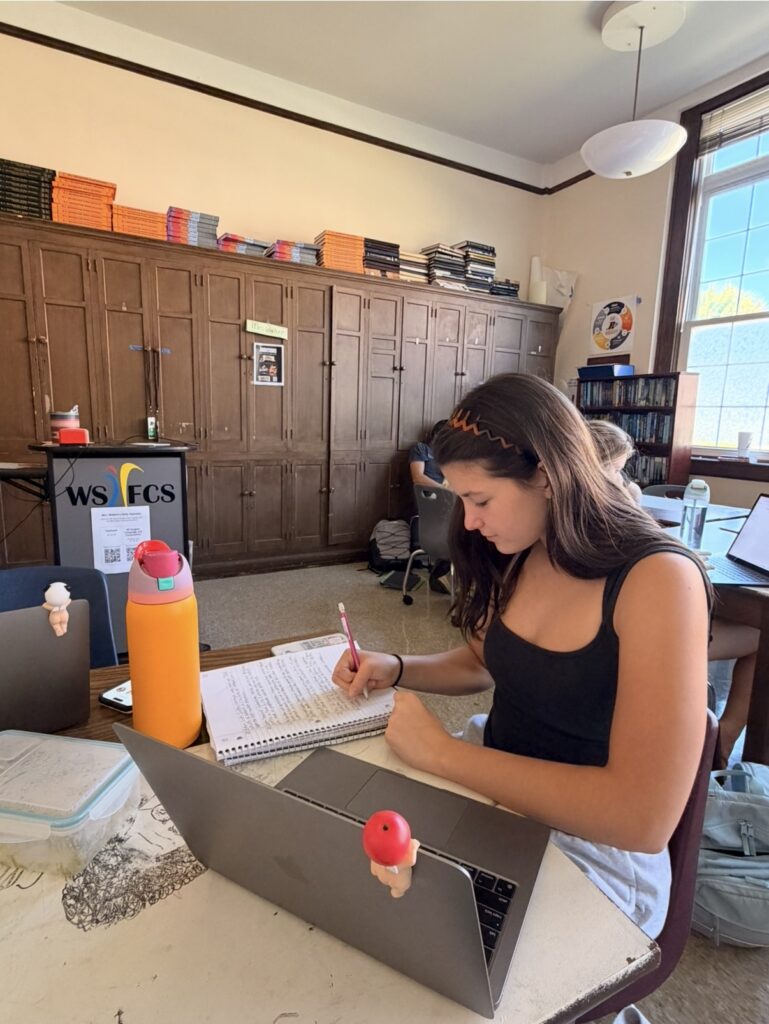
On top of this cumulative mental strain, many students at RJR begin attending the Career Center. This separate Winston-Salem Forsyth County high school offers students the opportunity to take AP courses, Career and Technical Education (CTE) courses, and other specialty classes they cannot get at their home high school. Although beneficial to students who want to broaden their course load, the separately located Career Center requires students to travel on buses or by car, which can increase strain on students both physically and mentally.
Attending the Career Center requires an earlier start time compared to RJR because classes begin at 8:00 am. The combination of more homework and an earlier wake-up time ultimately leads to less sleep for students. Take these factors into consideration, along with the chaos of attempting to leave the parking lot of the Career Center, and any empathetic person would have their mind reeling.
Secondly, all junior year students are offered the PSAT, a practice test for the SAT. The PSAT is the qualifying exam for the National Merit Scholarship Program, which provides recognition and college scholarships. Over the last several years, colleges are increasingly requiring students to submit their SAT or ACT scores with applications. All of this emphasis on test scores contributes to students’ heightened anxiety. Test scores alone can determine if a student is accepted or denied at certain schools, making the pressure to achieve high scores on standardized tests extreme.
Beyond testing, college applications entail writing essays and getting teacher recommendations. These recommendations often come from teachers in students’ junior-year classes. All of this means students feel they have to be at the top of their game the entire year.
Furthermore, many juniors find themselves deep in planning for their futures. Whether it’s college tours, thinking about joining the workforce, or enlisting in a branch of the armed services, students are inevitably overwhelmed by the options.
Finally, outside of academic points, the push to be involved in and even lead extracurricular activities is enough in itself to lose your mind. Often, juniors and seniors play varsity sports, which is a huge commitment that demands daily practices, and sometimes even practice or games on the weekends. As upperclassmen, younger students look up to them for guidance and leadership, regardless of whether they are a captain or not. Similarly, juniors can gain leadership roles in clubs in and outside of school, like the YMCA, churches, and other nonprofit organizations. These factors, combined with academic pressures, result in little to no free time, which can cause burnout. Part-time jobs and any semblance of a social life are afterthoughts during junior year.
All of this said, junior year can still be successful, and students can flourish. No one should be thinking they’re going to fail junior year at this point in September. The school year is just beginning, and the class of 2027 showed us we can pull through.
“I feel that I managed my time well,” RJR senior Anna Claire Wenker said when looking back on her junior year. “Classes were fun. Teachers were engaging. And I had a good balance between school and my social life.”