By Kate Sturgill
Staff Writer
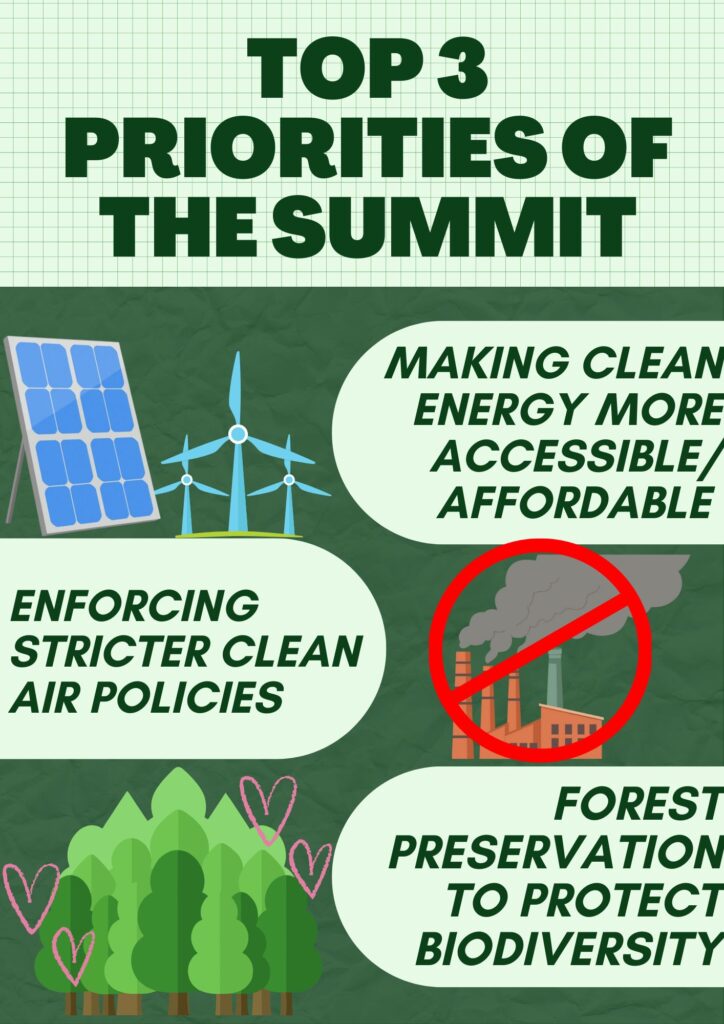
The top three goals of the G20 Summit are accessibility, protecting biodiversity, and stricter clean air policies.
Over the weekend of November 22, 2025, leaders across the globe met in South Africa to discuss environmental issues and possible solutions at the Johannesburg Expo Center. This year marked the twentieth meeting of the Group of 20 (G20), whose members include China, France, Germany, Russia, Saudi Arabia, the United Kingdom, and the United States.
Many conversations took place among these global leaders at the two-day summit, mostly focusing on stronger commitments to renewable energy, an increasingly valuable solution to pollution. These commitments push agencies to create programs, such as the USA’s Go Green Initiative, that can improve air quality for both the health of citizens and the overall cleanliness of the air. Air quality is currently poor worldwide because fossil fuels are being used at a rapid rate, depleting non-renewable energy sources and causing greenhouse gases to become trapped in the atmosphere, which heats the Earth.
“Many countries agreed to speed up their transition from fossil fuels to cleaner sources like solar and wind,” AP Environmental Science teacher Christie Rybak said. “That’s huge, because energy production is one of the largest contributors to greenhouse gas emissions.”
The nations in the Group of 20 account for 85% of the world’s Gross Domestic Product (GDP) and 75% of its trade; therefore, it is imperative that the leaders of these nations meet to discuss policies that limit the harsh effects of importing and exporting goods on the climate and the environment.
However, the absence of some world leaders raised eyebrows among many at the event. U.S. President Donald Trump, China’s Xi Jinping, and Russia’s Vladimir Putin did not appear in Johannesburg. This is problematic because these three countries, especially China and the United States, are among the world’s top emitters of carbon pollution. President Trump claimed that he boycotted the summit because South Africa was trafficking white citizens due to race, although there is no evidence to support that statement.. The 2026 G20 summit is planned to be held in Florida at a golf course owned by President Trump, and he plans not to invite South Africa for that reason.
Rybak encourages R.J. Reynolds High School students to use their voices to push leaders to get involved in the climate conversation before it is too late.
“A lot of the summit’s discussions talked about youth involvement and education,” Rybak said. “Leaders said that the next generation plays a huge role in creating solutions for climate change—whether it’s through voting or just making ecologically conscious choices in everyday life.”
Why should Reynolds care? How will conversations across the world affect students locally? Because the 2025 summit mainly focused on prioritizing clean air, the Environmental Protection Agency (EPA) recently created a program called Grant Funding to Address Indoor Air Pollution at Schools, which offers grants to low-income schools to improve indoor air quality. Reynolds is considered a Title 1 school, meaning over 40% of students qualify for free or reduced lunches, so it–or other schools in the area–could potentially receive funding for a new air quality system if the current one poses long-term health risks to students and staff.
According to epa.gov, the Go Green Initiative, which handles how grants for low-income schools are distributed, partners with the National School Boards Association to provide education and training to all officials involved in improving indoor air quality and reducing climate pollution across all 50 states. The initiative also provides assistance and capacity-building in low-income school districts throughout all EPA regions.
As long as students continue to stay educated and vocal about current climate issues, global environmental concerns can be prioritized and addressed more directly. Reynolds once had an environmental club with actively engaged students who worked to find small-scale solutions to local ecological issues like pollution and littering. Unfortunately, the club has not been active in years. However, with the pressing environmental issues highlighted at the G20 conference, youth participation in the environmental advocacy is pivotal. If students feel motivated to become more involved in Winston-Salem’s ecosystem, they can gather a group of friends and revive the environmental club–Reynolds is definitely in need of one.